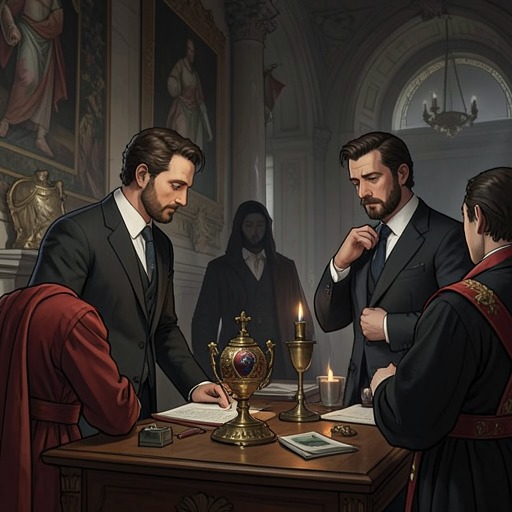
Herman Isaacstein
The Secret of ChimneysHerman Isaacstein is the financier at the center of the proposed restoration of the Herzoslovakian monarchy: his money is meant to help Prince Michael claim the throne, while the promised return is oil concessions. After Prince Michael is murdered, that financial arrangement makes Isaacstein a person of interest in Superintendent Battle’s inquiry as well as a potential partner in the next royal claim. His eventual willingness to transfer the same loan to Anthony Cade—who then reveals himself as Prince Nicholas—shows how readily political allegiance and royal identity can be recast around a continuing commercial bargain.
Identity and Background
Isaacstein is introduced as the representative of the syndicate George Lomax has discussed, identified in the conversation as an all-British syndicate. He is a major financier, and his position gives him a direct stake in the negotiations surrounding Herzoslovakia’s possible return to monarchy. The evidence does not specify his personal history or the syndicate’s full structure; his significance emerges through the capital he can supply and the concessions sought in exchange.
At Chimneys, Isaacstein appears in correct English shooting clothes that sit strangely on his large frame. The narration singles out his black eyes and powerful build, details that contribute to Superintendent Battle’s guarded assessment of him. His imposing appearance is balanced by a willingness to speak plainly: when Battle tells him that he, Lomax, and the Herzoslovakian Loyalist Party are all in a dangerous position, Isaacstein accepts the assessment and calls it accurate.
The Loan and the Restoration Plan
Isaacstein’s proposed transaction is tied to Prince Michael’s effort to regain the Herzoslovakian throne. At the time of Michael’s visit, the precise terms have not yet been settled, but the intended exchange is clear: Isaacstein’s interests would provide a loan, described as roughly a million pounds, while a successful restoration would bring oil concessions to companies in which he is interested. The British Government is prepared to support Michael’s claim because of his pronounced British sympathies, making the proposed loan part of a wider political arrangement rather than an isolated business deal.
The memoirs of Count Stylptitch threaten that arrangement. George Lomax fears that their publication could wreck the effort to restore the monarchy, and identifies Prince Michael as the proposed recipient of the crown. Lord Caterham’s response that readers enjoy reminiscences does not answer Lomax’s concern: the danger lies not in whether the memoirs will sell, but in their political effect at a sensitive moment. Isaacstein’s financial stake therefore depends on a fragile combination of royal legitimacy, political support, and the suppression of damaging disclosures.
Under Suspicion After Michael’s Murder
Once Prince Michael is killed, Battle approaches the case through motive. He insists that the first question is who benefits from the death, and warns Isaacstein and Lomax that they, along with the Loyalist Party, are exposed by the circumstances. The death has removed the claimant with whom Isaacstein was negotiating, while leaving the loan and prospective concessions embedded in a contested succession. Battle’s questioning turns Isaacstein’s business interest into a possible motive requiring examination, though the cited evidence does not establish that he had any part in the murder.
The succession question sharpens the predicament. When Battle asks who comes next, Lomax reluctantly identifies Prince Nicholas as the probable heir; Battle then presses the question of Nicholas’s identity. Later, he tells Anthony Cade that Nicholas Obolovitch, Michael’s first cousin, is the next heir and that authorities have reason to believe he has been in the United States raising money against his expectations. The heir’s uncertain whereabouts leave Isaacstein’s political-financial plan without its original royal partner and make the identity of the next claimant consequential.
Isaacstein remains under observation as Battle conducts the investigation. When he asks whether he may return to London, Battle refuses, explaining that his departure would encourage others to leave as well. Isaacstein then exits the room, closing the door behind him. The exchange presents him as a person whose movements matter to the inquiry, but it does not convert suspicion into proof. Later, when the revolver used in the case has not been found, Isaacstein suggests it may have been thrown into the lake; the suggestion is part of the discussion, not evidence that he knows where it is.
A Negotiator Who Can Change Claimants
After Prince Michael’s death, Isaacstein’s financial interest survives the loss of his original negotiating partner. Anthony raises the prospect that Isaacstein would not welcome the oil concessions going to another company and offers a suitable claimant who is strongly sympathetic to Britain. Isaacstein listens, asks for the proposition, and responds that he has learned to judge whether a person is telling the truth. He is prepared to discuss the same loan on the same conditions as the arrangement offered to Michael.
The willingness to repeat the offer reveals the continuity beneath the political crisis: the claimant can change, while Isaacstein’s financial terms remain. At the final meeting, he confirms that he originally came to negotiate a loan with Prince Michael and is asked whether he will offer it on the same terms to Michael’s cousin Nicholas. Isaacstein asks whether Anthony can produce the prince, since he believed Nicholas had been killed in the Congo. Anthony answers that he had spread the report of his own death and identifies himself as Nicholas Sergius Alexander Ferdinand Obolovitch, explaining that he had emerged from the Congo as Anthony Cade. Isaacstein’s encounter with the supposed intermediary thus becomes a negotiation with the royal claimant himself.
Narrative Role and Significance
Isaacstein connects the novel’s political succession plot to the practical mechanisms of finance. The restoration is not presented simply as a question of who has a hereditary claim: it also requires a loan, promises of oil concessions, and British backing. By making Isaacstein a participant in both the original plan for Prince Michael and the later negotiation with Prince Nicholas, the story shows how quickly the same commercial arrangement can attach itself to a new claimant when the political circumstances change.
His characterization also complicates the detective plot without resolving it by accusation. Battle has sound reason to ask who benefits from Michael’s death, and Isaacstein is among those with a conspicuous interest in the outcome. Yet the narrative’s available evidence gives him a defined role as financier and negotiator, not as murderer. His ability to evaluate Anthony’s honesty and continue bargaining makes him a practical counterweight to the uncertainty surrounding royal identity: even as the supposed death of Nicholas is exposed as a deliberate report, the proposed loan remains available on its original terms.